
Skylegs
  • Home
  • Modules
    • Schedule
    • Operations
    • Training
    • Sales
    • Finance
    • Safety (SMS)
    • Security (ISMS)
    • Compliance
    • Maintenance
    • Intelligence
    • System
    • Pilot
  • Apps
    • Electronic Flight Bag
    • Crew app
  • Pricing
  • Partners
  • News
  • About
  • Contact Us
  • Login
  • en_US
  • en_GB
  • Menu Menu
  • Link to Facebook
  • Link to Instagram
  • Link to LinkedIn

How manual data entry slows down flight operations

How manual data entry slows down flight operations

Efficiency in aviation management is often measured through visible metrics: fuel-burn rates, maintenance cycles, and crew scheduling. However, focusing solely on these physical variables overlooks a significant driver of operational success. Research into the impact of digital technologies on airline operations indicates that digital adoption accounts for 46% of the variance in operational efficiency. This suggests that nearly half of an operator’s ability to remain competitive is determined by the fluidity of their data rather than fleet size.

Despite the move toward digitalisation, a gap remains between the potential of modern software and the daily reality of many flight departments. Even when an organisation uses several digital tools, they often function as disconnected islands. This creates a “human bridge” where staff act as manual transporters, moving data between systems. This repetition is a structural bottleneck that compromises scalability and profitability.

The friction of the “human bridge”

In many aviation organisations, digitalisation is a misnomer. Teams might use specialised software for sales, another for scheduling, and yet another for safety reporting. When these systems do not communicate, the “human bridge” becomes a mandatory part of the workflow. Highly skilled operations managers spend hours transcribing passenger manifests or copying fuel burns from paper logs into spreadsheets.

This manual re-entry is the primary source of administrative overload. Every minute spent on data duplication is diverted from high-value tasks, such as fleet optimisation or managing client relationships. When data cannot flow automatically from a sales quote to a flight schedule, or from a pilot’s log to a finance report, the business remains trapped in a reactive state.

The cost of information decay

Beyond the immediate loss of time, manual entry leads to information decay. In a fragmented system, a client’s special request recorded by the sales team often “dies” within the sales software. For that information to reach the crew, it must be manually extracted and re-entered into a briefing package.

This process is prone to error and lag. When updates are managed via a sea of emails and manual spreadsheets, the most current requirements are easily lost. For executives, this represents a financial leak. Administrative overhead increases as the company grows, but because the underlying workflow is inefficient, the return on that extra effort diminishes. If nearly half of operational performance is tied to digital maturity, relying on manual entry directly compromises the ability to scale.
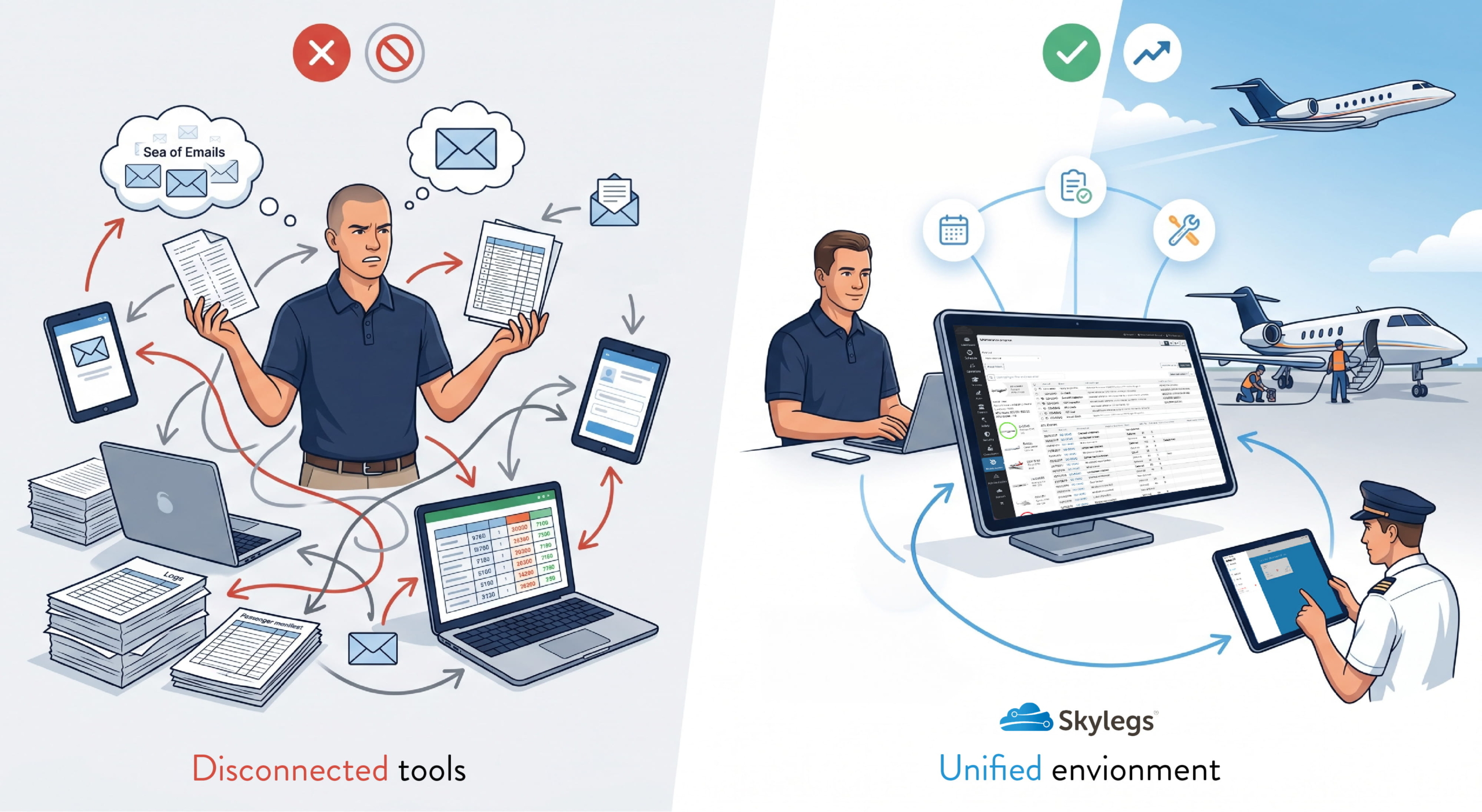
Transitioning to a unified environment

To resolve this, the “human bridge” must be replaced with a unified environment. The goal is a system where data is captured once at its point of origin and flows through the entire organisation without further intervention.

Skylegs applies this single-entry logic to centralise operational data. This ensures that the people executing a mission (from the operations room to the cockpit) work with the exact same information as the team that sold the flight. By removing the need for departments to act as data gatekeepers, the platform eliminates the administrative bottlenecks that typically stifle growth.

This coordination is most effective when it extends into live operations. For example, when a pilot uses the Skylegs Crew App to enter post-flight fuel burns or update passenger details on the ramp, that data synchronises across all modules in real time.

The finance department receives accurate data for immediate invoicing, and the maintenance department gets instant updates on aircraft hours. No one has to “send” the data; it is simply there. This shift from fragmented tools to a single system of record provides the operational clarity needed to manage aviation at scale, ensuring that the team’s energy is spent on flight operations rather than data entry.

Conclusion

Closing the efficiency gap in flight operations requires removing the friction of manual re-entry. Since nearly half of an operator’s efficiency depends on how well their digital systems move data, keeping tools disconnected leads to higher overhead and operational risk. By transitioning to a unified environment, organisations stop acting as data gatekeepers and start operating as strategic businesses. The path to scaling is not found in hiring more staff to manage spreadsheets, but in ensuring that data is entered once and used everywhere.

Contact Skylegs and learn how to improve efficiency of your operations team.

Title – subscribtion

Follow our story via mail

Categories

  • Aviation technology & systems
  • Industry insights
  • Operations & workflow
  • Product & platform insights
  • Safety & compliance

Recent Posts

  • How manual data entry slows down flight operations
  • SIFL Reports: Let Skylegs Take Care of Them for You
  • Skylegs’ new Information Security Management System (ISMS)/Part-IS module
  • Skylegs 2025 year review: strong foundations, innovation, security and flexibility
  • ReFuelEU Aviation Regulation made easy with Azzera Celeste and Skylegs integration
  • Like us on Facebook
  • Find us on LinkedIn
  • See us on Instagram
  • +32 3 658 84 80
  • +1 (857) 957 7637
  • info@skylegs.com
  • Terms of Use
  • Privacy
  • Cookies policy
  • ISO/IEC 27001:2022 certificate

Headquarters

Luchthavenlei 7a box 7
2100 Antwerp
Belgium | BE 0535 618 954

North American Office

6 Liberty Square #2246
Boston, MA 02109
United States

  • Home
  • Modules
  • Electronic Flight Bag
  • Partners
  • News
  • About
  • Contact Us
  • Login
  • en_US
  • en_GB
© Copyright 2024 - Skylegs BV - All rights reserved
  • Link to Facebook
  • Link to Instagram
  • Link to LinkedIn
  • Home
  • Modules
  • Apps
  • Pricing
  • Partners
  • News
  • About
  • Contact Us
  • Login
  • en_US
  • en_GB
Link to: SIFL Reports: Let Skylegs Take Care of Them for You Link to: SIFL Reports: Let Skylegs Take Care of Them for You SIFL Reports: Let Skylegs Take Care of Them for You
Scroll to top Scroll to top Scroll to top

This site uses cookies. By continuing to browse the site, you are agreeing to our use of cookies. We use them solely for Google analytics and website functionalities.

OKLearn more

Cookie and Privacy Settings


How we use cookies

We may request cookies to be set on your device. We use cookies to let us know when you visit our websites, how you interact with us, to enrich your user experience, and to customize your relationship with our website.

Click on the different category headings to find out more. You can also change some of your preferences. Note that blocking some types of cookies may impact your experience on our websites and the services we are able to offer.

Essential Website Cookies

These cookies are strictly necessary to provide you with services available through our website and to use some of its features.

Because these cookies are strictly necessary to deliver the website, refusing them will have impact how our site functions. You always can block or delete cookies by changing your browser settings and force blocking all cookies on this website. But this will always prompt you to accept/refuse cookies when revisiting our site.

We fully respect if you want to refuse cookies but to avoid asking you again and again kindly allow us to store a cookie for that. You are free to opt out any time or opt in for other cookies to get a better experience. If you refuse cookies we will remove all set cookies in our domain.

We provide you with a list of stored cookies on your computer in our domain so you can check what we stored. Due to security reasons we are not able to show or modify cookies from other domains. You can check these in your browser security settings.

Google Analytics Cookies

These cookies collect information that is used either in aggregate form to help us understand how our website is being used or how effective our marketing campaigns are, or to help us customize our website and application for you in order to enhance your experience.

If you do not want that we track your visit to our site you can disable tracking in your browser here:

Other external services

We also use different external services like Google Webfonts, Google Maps, and external Video providers. Since these providers may collect personal data like your IP address we allow you to block them here. Please be aware that this might heavily reduce the functionality and appearance of our site. Changes will take effect once you reload the page.

Google Webfont Settings:

Google Map Settings:

Google reCaptcha Settings:

Vimeo and Youtube video embeds:

Other cookies

The following cookies are also needed - You can choose if you want to allow them:

Privacy Policy

You can read about our cookies and privacy settings in detail on our Privacy Policy Page.

Privacy

Accept settingsHide notification only
We've detected you might be speaking a different language. Do you want to change to:
en_GB English (UK)
en_GB English (UK)
en_US English (United States)
Change Language
Close and do not switch language