
How manual data entry slows down flight operations
Efficiency in aviation management is often measured through visible metrics: fuel-burn rates, maintenance cycles, and crew scheduling. However, focusing solely on these physical variables overlooks a significant driver of operational success. Research into the impact of digital technologies on airline operations indicates that digital adoption accounts for 46% of the variance in operational efficiency. This suggests that nearly half of an operator’s ability to remain competitive is determined by the fluidity of their data rather than fleet size.
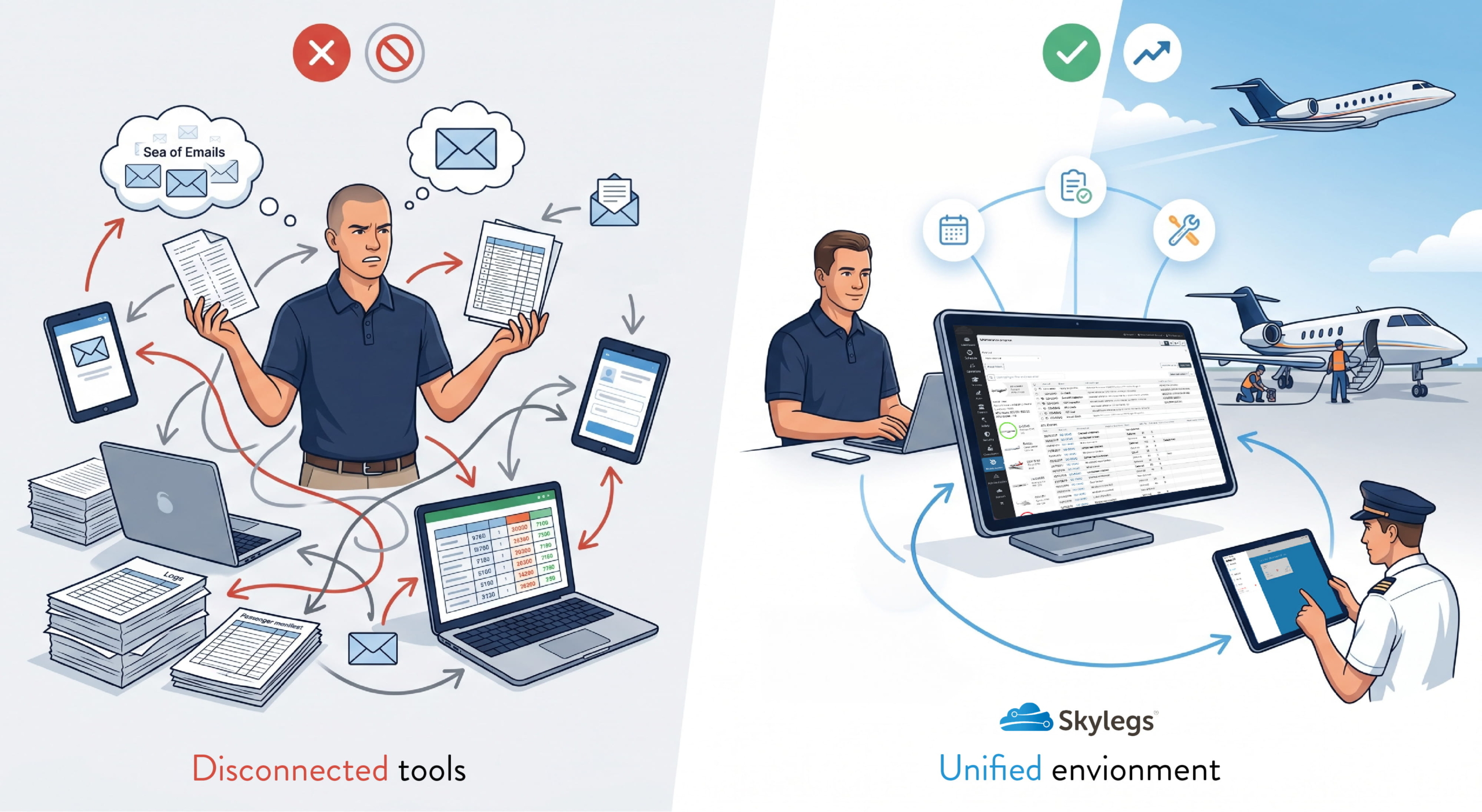
Despite the move toward digitalisation, a gap remains between the potential of modern software and the daily reality of many flight departments. Even when an organisation uses several digital tools, they often function as disconnected islands. This creates a “human bridge” where staff act as manual transporters, moving data between systems. This repetition is a structural bottleneck that compromises scalability and profitability.
The friction of the “human bridge”
In many aviation organisations, digitalisation is a misnomer. Teams might use specialised software for sales, another for scheduling, and yet another for safety reporting. When these systems do not communicate, the “human bridge” becomes a mandatory part of the workflow. Highly skilled operations managers spend hours transcribing passenger manifests or copying fuel burns from paper logs into spreadsheets.
This manual re-entry is the primary source of administrative overload. Every minute spent on data duplication is diverted from high-value tasks, such as fleet optimisation or managing client relationships. When data cannot flow automatically from a sales quote to a flight schedule, or from a pilot’s log to a finance report, the business remains trapped in a reactive state.
The cost of information decay
Beyond the immediate loss of time, manual entry leads to information decay. In a fragmented system, a client’s special request recorded by the sales team often “dies” within the sales software. For that information to reach the crew, it must be manually extracted and re-entered into a briefing package.
This process is prone to error and lag. When updates are managed via a sea of emails and manual spreadsheets, the most current requirements are easily lost. For executives, this represents a financial leak. Administrative overhead increases as the company grows, but because the underlying workflow is inefficient, the return on that extra effort diminishes. If nearly half of operational performance is tied to digital maturity, relying on manual entry directly compromises the ability to scale.
Transitioning to a unified environment
To resolve this, the “human bridge” must be replaced with a unified environment. The goal is a system where data is captured once at its point of origin and flows through the entire organisation without further intervention.
Skylegs applies this single-entry logic to centralise operational data. This ensures that the people executing a mission (from the operations room to the cockpit) work with the exact same information as the team that sold the flight. By removing the need for departments to act as data gatekeepers, the platform eliminates the administrative bottlenecks that typically stifle growth.
This coordination is most effective when it extends into live operations. For example, when a pilot uses the Skylegs Crew App to enter post-flight fuel burns or update passenger details on the ramp, that data synchronises across all modules in real time.
The finance department receives accurate data for immediate invoicing, and the maintenance department gets instant updates on aircraft hours. No one has to “send” the data; it is simply there. This shift from fragmented tools to a single system of record provides the operational clarity needed to manage aviation at scale, ensuring that the team’s energy is spent on flight operations rather than data entry.
Conclusion
Closing the efficiency gap in flight operations requires removing the friction of manual re-entry. Since nearly half of an operator’s efficiency depends on how well their digital systems move data, keeping tools disconnected leads to higher overhead and operational risk. By transitioning to a unified environment, organisations stop acting as data gatekeepers and start operating as strategic businesses. The path to scaling is not found in hiring more staff to manage spreadsheets, but in ensuring that data is entered once and used everywhere.
Contact Skylegs and learn how to improve efficiency of your operations team.


