How your operator platform supports stress-free audits
For many compliance and safety teams, the approach of a regulatory audit triggers a predictable cycle of administrative stress. Traditional audit preparation often requires a reactive scramble to assemble disparate physical records, compile scattered PDFs, and track down missing signatures across multiple departments. This manual compilation is time-consuming and leaves the organisation vulnerable to oversight errors.
Audit readiness should not be a disruptive, seasonal event, but a continuous, passive state embedded within daily aircraft operations. When operational data is unified and managed systematically within the Skylegs platform, a Civil Aviation Authority (CAA) inspection stops triggering chaos. Instead, it becomes a routine validation of a workflow already running smoothly in the background, reducing administrative anxiety.
Controlled transparency
Managing the scope of an external inspection affects efficiency for both the operator and the inspector. Because a comprehensive aviation platform handles everything from sales to fleet maintenance, navigating the ecosystem without a defined path can overwhelm an auditor with irrelevant data, slowing down the review process.
To resolve this, the Skylegs platform uses granular user permissions to establish focused transparency. Rather than navigating a separate, isolated system or being left to sift through an extensive database, auditors log in with accounts configured with precise viewing rights tailored to the audit’s objective. Inspectors can independently access the required flight logs, training records, and compliance certificates without distraction from unrelated departmental workflows. This creates a streamlined, professional environment where the auditor can work autonomously within regulatory parameters.
The chain of evidence
The strength of a compliance department relies on its ability to cross-reference data across the entire organisation. In fragmented systems, verifying a single detail often requires pulling disjointed logs from separate tools, creating delays and information gaps.
When compliance, scheduling, operations, and training modules are natively connected, they form a chain of evidence. If an inspector needs to verify that a crew member was qualified and signed off on the latest document prior to a specific flight, the Skylegs platform provides immediate visibility. The records, qualifications, and signatures are linked directly to the flight log via automated timestamps. Because the data is unified, compliance teams avoid manually coordinating between departments; the system validates itself instantly.
Data integrity
The primary objective of a regulatory inspector is to verify that an operator’s data is authentic, accurate, and has not been retroactively altered. Proving the integrity of historical records requires a robust technical foundation.
Operating within an ISO 27001-certified environment ensures that all data handling meets strict international information security standards. Actions, document uploads, and status changes within the platform generate a permanent, tamper-proof audit trail. Crucially, the full history of correspondence between auditors and auditees within a finding remains unalterable. This transparency gives inspectors immediate confidence in the authenticity of the data, which naturally accelerates the review process and reinforces the operator’s credibility.
Audit findings
While external inspections represent the ultimate test of compliance, maintaining high standards requires continuous internal oversight. Relying on disconnected Excel spreadsheets to track internal audit findings often leads to missed deadlines and untracked corrective actions.
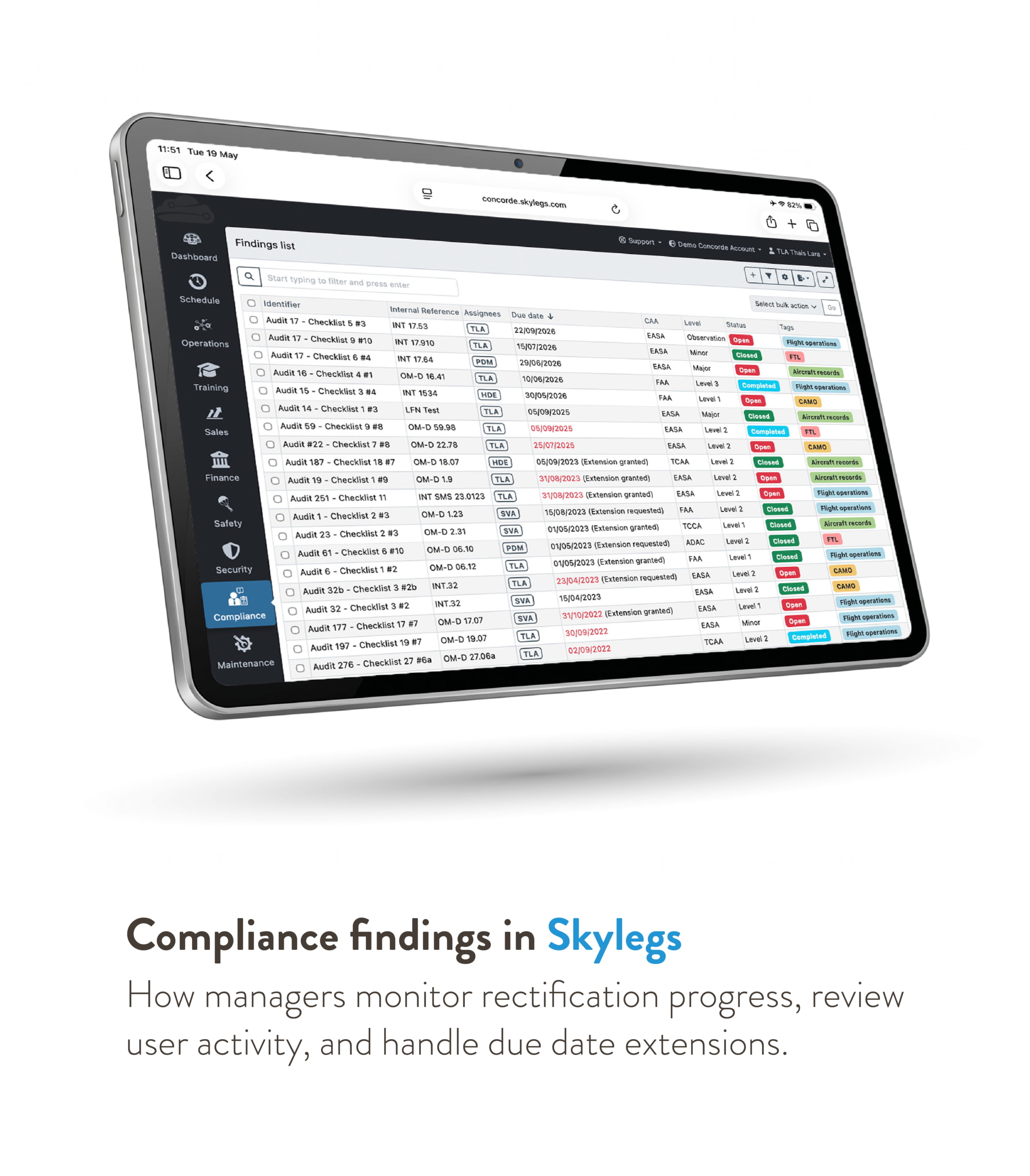
The Skylegs platform replaces manual tracking processes with a centralised compliance module designed for proactive governance. Internal findings can be opened, documented, and assigned directly to specific individuals or operational groups. Compliance managers can monitor rectification progress in real time, review precise user activity logs, and manage due-date extension requests. This approach ensures that potential non-compliance issues are identified, tracked, and resolved early, keeping the organisation’s internal oversight airtight well before an external audit begins.
Conclusion
Transitioning from a reactive audit scramble to a state of continuous readiness requires moving from fragmented tools to an interconnected platform like Skylegs. By embedding compliance directly into daily workflows, protecting data boundaries with granular permissions, and anchoring records in an ISO 27001-certified environment, operators can welcome inspections with confidence. True audit readiness does not disrupt daily flight operations; it protects them.

